Tax Deductions for Engineers Australia 2026-27: What You Can Claim
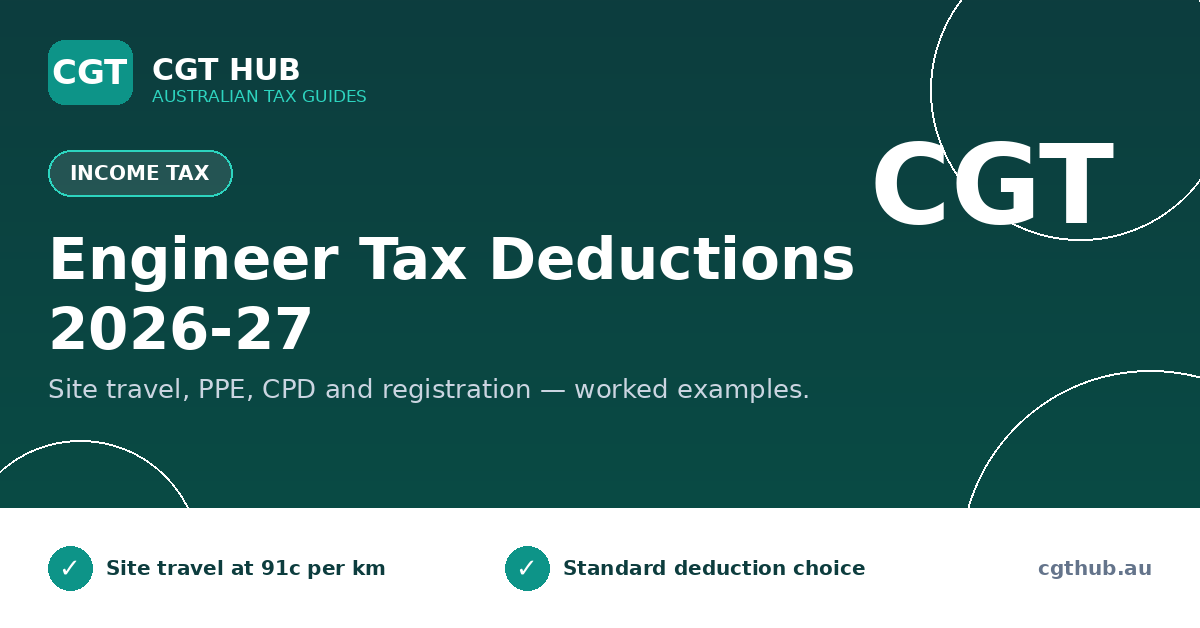
If you are an engineer in Australia, your 2026-27 tax return works differently from every year before it. Eligible employees now get a standard deduction of up to $1,000 for work-related expenses with no receipts required — but if you claim more than that, you need written evidence for every dollar, because the old $300 no-receipts exception is gone. This guide covers what engineers can claim at verified ATO rates, and the dollar maths on itemising versus taking the $1,000.
The quick answer: claim what you paid for yourself, for your current job, with records. Steel caps, site travel, memberships, current-role CPD and the work share of phone and tools are in. Your commute, business shirts, employer-supplied gear and first registration fee are out. The rest covers the boundary cases, where engineers lose money.
At a glance: what engineers can and cannot claim
| Expense | Claimable? | Key condition |
|---|---|---|
| Steel-capped boots, hard hat, hi-vis, safety glasses, gloves | Yes | You paid for them; they protect against a real site risk |
| Business shirts, suits, jeans, ordinary drill pants | No | Conventional clothing, even if worn only at work |
| Laundry of claimable clothing | Yes | $1 per work-only load; 50c per mixed load |
| Office-to-site, site-to-site, home-to-alternative-workplace travel | Yes | At 91c/km (cents per km, max 5,000 km) or logbook |
| Home-to-regular-workplace commute | No | Private, even if the site is far away or the hours are odd |
| Tools and equipment $300 or less | Yes, in full | Work share only; not part of a set costing more than $300 |
| Tools, laptop, software over $300 | Yes, depreciated | Claim the decline in value over its effective life, work share only |
| Engineers Australia / professional memberships, union fees | Yes | Related to your current role; claimed on top of the $1,000 standard deduction |
| First registration or first licence to get the job | No | Renewals while working are claimable |
| CPD and self-education for your current role | Yes | Must maintain or improve skills for your current duties, not open a new occupation |
| Phone and internet, work share | Yes | Apportioned by actual work use; not double-claimed under the WFH fixed rate |
| Working from home, fixed rate | Yes | 70c per hour worked from home, with a record of actual hours |
| Employer-supplied or reimbursed items | No | If someone else paid, it is not your deduction |
| Driver’s licence, meals on a normal shift, fines, entertainment | No | Private expenses; overtime meals only with an overtime meal allowance |
Every claim must clear the ATO’s three golden rules: you spent it yourself and were not reimbursed, it directly relates to your current job, and you have a record to prove it. Part work, part private? Claim only the work portion.
Protective clothing, uniforms and laundry
This is the category engineers get wrong most often. The ATO does not care whether you only wear something at work — it cares whether the clothing protects you from a specific risk of your job, or distinctly identifies you as an employee of a particular employer.
Claimable: steel caps, hard hats, hi-vis, fire-resistant clothing, safety glasses, gloves and breathing masks — bought yourself, worn because the site or work demands them. The ATO guide’s civil engineer in steel caps and a hard hat on site is the textbook case.
Not claimable: business attire, jeans, drill shirts, shorts, trousers, socks and closed shoes — even if your employer expects them and you never wear them elsewhere. Engineers do not wear occupation-specific clothing, per the ATO guide. One exception: a shirt embroidered with your employer’s logo can count as a compulsory uniform — but the plain drill pants worn with it cannot, and washing them together makes the load mixed at 50c.
Laundry follows the same logic: $1 per load for work-only loads, 50c for mixed loads. Forty work-only loads is $40; the same forty mixed is $20. Keep a simple count — loads per week times weeks worked. From 2026-27, itemising means you need records for laundry too: the old $150 exception without written evidence is gone.
Car and site travel: the commute boundary
Normal trips between home and your regular workplace are private, even if you live far away, work weekends or start before dawn. What is claimable:
- Office to a job site, client, supplier or head office during the day, and back.
- Directly between two separate jobs on the same day (neither place your home).
- Home directly to an alternative workplace — a client’s premises or a site that is not your regular workplace — then on to your regular workplace. The ATO’s structural-engineer example allows exactly this.
- Parking and tolls on work trips (not parking near your regular workplace, nor tolls on the commute).
Two traps. First, “my site keeps changing”: based at a site for weeks or months, home-to-site trips are still your commute — it is your regular workplace for that period. Shifting places of employment needs genuinely no fixed workplace and continual site-to-site travel. Second, the salary-sacrifice or novated-lease car: your employer leases it, so no car expenses are claimable — though parking and tolls on work trips still are.
The 2026-27 car rate — and the stale rates still floating around
For 2026-27, the cents-per-kilometre rate is 91c per kilometre, up to 5,000 work kilometres per car — a maximum of $4,550 (an 89c base plus a one-off 2c uplift for 2026-27 only). Do not copy last year’s figure: 88c was the 2025-26 rate. Pages still showing 92c for engineers match no ATO determination for any year, and overstate a full 5,000 km claim by $50. Over 5,000 work kilometres, or with an expensive car, compare the logbook method: no cap, actual costs at your business-use percentage, but a valid 12-week logbook and receipts are required. Fuel, servicing, registration and insurance cannot be claimed on top of the rate — it already covers them. Utes carrying one tonne or more, and vehicles carrying nine or more passengers, cannot use either method and must claim actual expenses.
The bulky-tools test: all three conditions, or nothing
One narrow exception: carrying bulky tools. All three ATO conditions must hold: the tools are essential to your duties; bulky — awkward by size and weight, only conveniently carried by car; and no secure storage at work. The guide’s mechanical engineer carrying large machines daily with no employer storage passes. If your site has a lock-up and you bring gear home by choice, the trip is private.
FIFO engineers: the split the ATO actually draws
The engineers guide does not cover FIFO work, hence the muddled advice. The ATO’s travel ruling gives a WA mining example: a worker living in Sydney, rostered on and paid only from arrival at Perth airport, cannot claim home to Perth airport, including the Sydney flight. Onward travel to the site can be deductible only if the engineer pays personally. Check when your paid roster starts before claiming a year of flights.
Tools, equipment and software
Engineers buy their own gear more often than most office workers: laser measures, multimeters, hand tools, a personal laptop for modelling, and CAD or simulation subscriptions. The rules turn on price and on who paid.
An item costing $300 or less — not part of a set over $300 — can generally be claimed in full in the year you buy it, at its work-use share: a $280 laser measure used only for work is a $280 deduction. Items over $300 are claimed as decline in value over their effective life. Repairs, insurance, technical books, standards subscriptions and self-funded software for your current role follow the same work-share pattern.
The employer-paid rule overrides all of this. If your firm supplies the laptop, phone, licence or PPE, you cannot claim it, however heavily you use it; reimbursement has the same result. Only the gap you paid is claimable. A tool allowance on your income statement is income — claim what you actually spent, with records. The ATO’s example: a mechanical engineer on a $650 tool allowance buys a $764 gauge — she declares the $650 and claims the gauge’s decline in value.
Professional memberships, registration and union fees
Membership of Engineers Australia, a chartered body, or another association directly related to your current role is deductible, as are union fees. Keep the renewal invoice — records are still required, even though these sit outside the standard deduction (next section). Two limits: unrelated membership is capped at $42 a year per association, and registration follows the getting-the-job versus doing-the-job line. Initial registration and first licences (e.g. forklift) are not claimable; renewals and extra licences your duties require, such as a heavy vehicle permit, are. An ordinary driver’s licence is never deductible.
Self-education and CPD
CPD is where engineers most often over-claim with good intentions. The test is not “will this help my career” — it is whether the study maintains or improves the skills for your current duties, or is likely to increase your income from your current employment. A Master of Engineering extending your current specialisation passes; a course qualifying you for a different occupation does not — the ATO’s draftsperson studying for a mechanical engineering degree fails. Short courses, conferences and seminars follow the same logic, including fares, registration and overnight accommodation and meals. Apportion mixed trips; a catered lunch does not taint a work trip, but a bolted-on holiday does. One quirk: a self-education deduction may need a $250 reduction, offset by certain non-deductible expenses — check the D4 instructions before lodging a large study claim.
Phone, internet and working from home
Claim the work share of your own plan and devices via a four-week representative record: work use against total use, applied to your bill, times months worked. A mechanical engineer on a $59 plan with 20% work calls claims $11.80 a month. Family calls are private even on work travel; an employer-provided phone is not claimable.
One change: the old shortcut allowing up to $50 of incidental phone and internet use with limited records ends from 1 July 2026. From 2026-27, itemising phone and internet needs the ordinary records. Do not rely on a guide that still presents the $50 shortcut as current.
Working from home uses the fixed rate: 70c per hour actually worked from home. Set from 1 July 2024 under the ATO’s guideline, it covers energy, phone, internet, stationery and computer consumables in one figure, and no different 2026-27 rate had been announced at the time of writing — work from 70c, re-checking before lodging in 2027. You need a record of every hour for the whole year; estimates are not accepted. Home-office equipment depreciation can still be claimed separately, but nothing the rate covers can be claimed again. If your phone use is mainly out and about, consider the actual cost method for everything instead.
The $1,000 standard deduction vs itemising, in dollars
From 2026-27, eligible taxpayers — Australian residents earning salary or wages — automatically receive a standard deduction of up to $1,000 for work-related expenses, with no spending or records required. It is a deduction from taxable income, not a $1,000 refund, reduced dollar for dollar by covered work expenses you claim. The part most summaries skip: union fees and professional memberships do not reduce it — claim those on top, with records. Donations, tax-agent fees, income protection and personal super are likewise unaffected. But car, WFH, uniform, laundry, tool, study and decline-in-value claims all reduce it. Claim $600 and your standard deduction drops to $400: $1,000 either way, with more paperwork. Under $1,000, take the standard deduction. Over $1,000, itemise — with written evidence for all of it.
| Engineer profile | Covered expenses itemised | Standard path total | Itemised wins by | Tax saved at 30% |
|---|---|---|---|---|
| Site-based civil engineer (Example 1) | $3,648 | $1,000 | $2,648 | $794 |
| Hybrid design engineer (Example 2) | $1,585 | $1,000 | $585 | $176 |
| Office-based graduate (Example 3) | $620 | $1,000 | −$380 (standard wins) | $114 by taking standard |
In all three rows, memberships sit on top of either path. Tax savings use a 30% marginal rate and exclude the Medicare levy — your saving is your extra deduction times your own marginal rate. Check your bracket with our income tax calculator.
Worked examples with real 2026-27 figures
Example 1: Maya, site-based civil engineer — itemising wins big
Maya earns $118,000 and spends most weeks on Brisbane sites. Her covered expenses: car travel 2,800 work kilometres at 91c = $2,548; self-bought PPE $420; laundry, 40 work-only loads at $1 = $40; a $280 laser measure; and the work share of laptop decline in value, $360. Total: $3,648. Her $450 Engineers Australia membership (illustrative figure) sits outside the standard deduction, claimable on top either way.
Standard path: $1,450. Itemised: $4,098 — $2,648 more, worth $794.40 at 30%. But she must hold receipts and a kilometre record for the lot: from 2026-27 itemising needs evidence for every dollar.
Example 2: Daniel, hybrid design engineer — itemising wins narrowly
Daniel works two days a week from home: 736 home hours (two days, 46 weeks, eight hours a day), so his WFH claim is 736 × 70c = $515. Add an $890 CPD course for his current structural design role and $180 work share of software subscriptions. Total: $1,585.
Itemising wins by $585, worth $175.50 at 30%. Note what Daniel did not claim: separate phone and internet for his home hours, because the 70c rate already covers them. His membership sits on top either way.
Example 3: Priya, office-based graduate — the standard deduction wins
Priya works in an office, wears business attire, and her employer supplies her laptop and phone. Her covered expenses total $620: $240 work share of her personal phone (she does not use the WFH fixed rate), $180 in technical books and stationery, and a $200 short course for her current role. Itemising gives $620 with records; the standard deduction gives $1,000 with none — $380 more, worth $114 at 30%. She should claim nothing, take the $1,000, and still claim her membership on top.
Contractor vs employee: the PSI pointer
Everything above is for engineers on salary and wages. Contracting through an ABN or company brings a different regime: income mainly rewarding your personal skill, labour or expertise — over 50% of a contract payment — is personal services income (PSI). If the PSI rules apply and you pass none of the personal services business tests (results, unrelated clients, employment, business premises), income is attributed to you personally and deductions are broadly limited to what an employee could claim. Get advice on your structure before assuming company deductions. See also our electricians’, plumbers’ and FIFO workers’ guides.
Common mistakes and traps
- Claiming the commute. Home to your regular site is private, however far or early. Only alternative workplaces, between-job travel and bulky tools change that.
- Claiming employer gear. Supplied or reimbursed is not yours to claim — laptop, phone, PPE, licence, CPD fees. Claim only the gap you paid.
- Claiming business attire. Suits are conventional clothing; steel caps are protective. “I only wear it at work” is not the test.
- Double-claiming under the WFH rate. The 70c rate already includes phone, internet, energy and stationery.
- Copying a stale car rate. 88c was 2025-26; 92c matches no ATO year. Use 91c/km, capped at 5,000 km.
- Itemising $600 and losing the standard deduction for nothing. Covered claims reduce the $1,000 dollar for dollar. Under $1,000, take the standard deduction.
- Assuming an allowance is a deduction. Allowances on your income statement are income; you claim what you actually spent, with records. A height or disability allowance compensating you for unpleasant work is not a deduction at all.
- Forgetting the record rule change. From 2026-27, itemising above $1,000 needs written evidence for every covered dollar.
Frequently asked questions
My site changes every few weeks. Is home-to-site travel claimable?
Only if you genuinely have no fixed workplace and continually move site to site. Based at one site for a stretch, even a few weeks, and home-to-site trips are your commute. Trips from that site to other sites, clients or the office during the day are claimable.
My employer gives me a laptop and a phone. Can I still claim anything?
Not for those items — anything supplied or reimbursed is excluded. But you can still claim what you paid for yourself: tools, PPE, memberships, CPD, car travel between workplaces, and a personal phone plan used for work.
I paid for my first engineer registration. Is that deductible?
No. Initial registration, like a first licence, is a cost of getting the job, not doing it. Renewals while working in the role are deductible, as are additional licences your duties require.
Do I itemise or just take the $1,000 standard deduction?
Add up your covered expenses (car, WFH, uniforms, laundry, tools, study, decline in value). Under $1,000, take the standard deduction — same or better result, no records. Over $1,000, itemise with full records. Memberships and union fees sit on top either way, so leave them out of the crossover maths. See our standard $1,000 deduction guide and car expenses guide.
I work FIFO. Are my flights deductible?
Home to your departure airport is private, and any employer-paid or reimbursed flight is not yours to claim. Onward travel to the site can be deductible if you pay for it yourself — but it turns on when your paid roster starts and who paid, so check both before claiming.
Engineers’ deductions reward one habit: keeping records as you go. Photograph receipts, log site trips when you make them, count home hours weekly. That habit is worth real money in 2026-27 — either it pushes you past $1,000 and justifies itemising, or it tells you early the standard deduction already wins. Final check: our income tax calculator and income tax rates guide.
General information only, based on ATO guidance checked 31 October 2026; consider a registered tax agent for your own return. Sources: ATO: Standard deduction for work-related expenses; ATO: Cents per kilometre method; ATO: Engineer expenses (occupation guide).