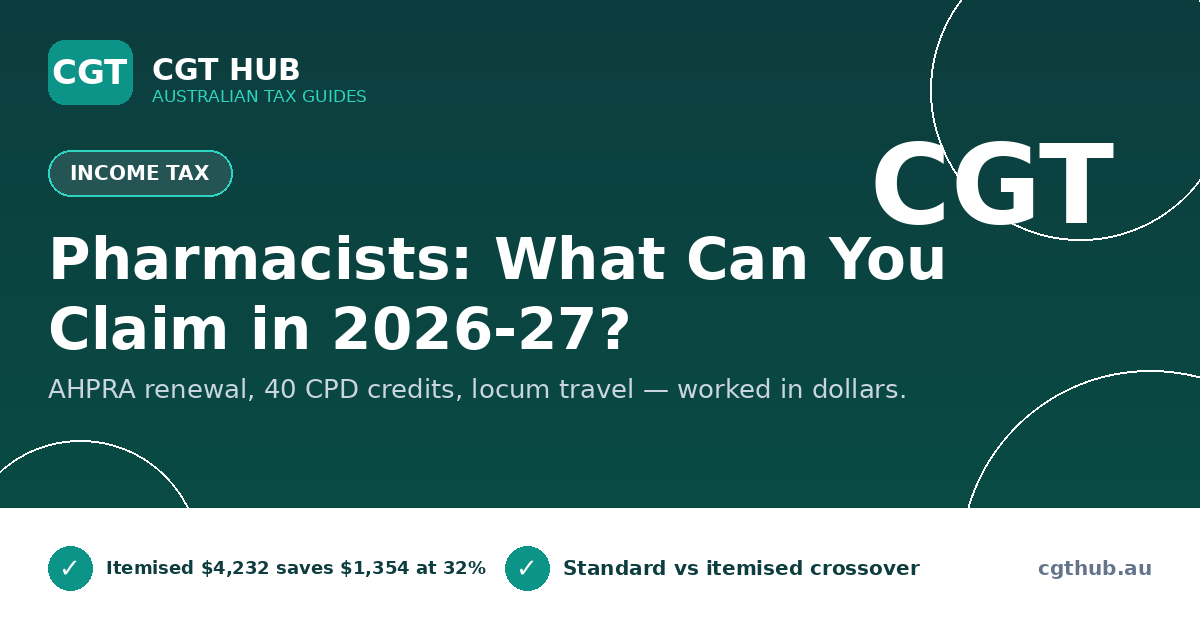
If you are a pharmacist in Australia, your tax return has a shape most professions do not: a registration fee you must pay every year to practise at all, 40 CPD credits you must earn on a timetable that does not match the tax year, and a working week that can span two or three pharmacies, a vaccination clinic, and a string of home medicine reviews. Each of those is a deduction waiting to be claimed — and each has a trap attached. Get the year right and the difference is worth real money: on a $105,000 salary, a well-documented claim can be worth $1,354 in tax saved, against just $320 from the new standard deduction. This guide works through what you can claim in 2026-27, what you cannot, and the mistakes that cost pharmacists their claims.
The quick answer
Employed pharmacists can claim the work-related costs they paid themselves and were not reimbursed for: AHPRA registration renewal, Pharmaceutical Society of Australia (PSA) or Pharmacy Guild membership, professional indemnity insurance you paid yourself, CPD courses and immunisation training, conference travel, travel between pharmacies and between patient homes, work-related phone and internet use, home-office running costs for CPD and admin, and laundry for lab coats and compulsory uniforms. You cannot claim your initial registration, your own medicines, your drive from home to your regular pharmacy, or conventional clothing. And in 2026-27 there is a new fork in the road: you can take the $1,000 standard work-related deduction instead of itemising — but you cannot take both, and if you itemise above $1,000 you need written evidence for your claims.
What pharmacists can claim in 2026-27
| Expense | Claimable? | Conditions |
|---|---|---|
| AHPRA registration renewal | Yes | Ongoing renewal only, not the initial registration; $504 from 1 October 2026 ($531 in NSW) |
| PSA, Guild or SHPA membership and journal subscriptions | Yes | Related to your current role |
| Professional indemnity insurance | Yes | Only the part you paid yourself; it is a registration requirement, so most pharmacists hold it |
| CPD courses, immunisation training and conferences | Yes | Must maintain or improve skills in your current role |
| Travel between pharmacies, and between patient homes | Yes | 91c per km in 2026-27; home to your regular pharmacy excluded |
| Lab coats, compulsory uniforms and laundry | Yes | Uniform must be compulsory or carry a logo; laundry at a reasonable rate |
| Phone and internet (work use) | Yes | Work percentage only, with a reasonable basis |
| Home office (CPD, notes, admin) | Yes | Fixed rate or actual costs; keep a diary of hours |
| Intern training program and intern self-education | Yes | Intern pharmacists only; must relate to the intern role |
| Initial AHPRA registration | No | Cost of entering the profession, not of earning income in it |
| Your own medicines and health costs | No | Private, even bought at your own pharmacy with a staff discount |
| Travel from home to your regular pharmacy | No | Private travel, even if you drive a long way |
| Conventional clothing and shoes | No | Even if you only wear them at work |
The 2026-27 numbers that drive the claim
Three figures decide whether itemising beats the standard deduction for you. First, the resident tax rates for 2026-27: nil on the first $18,200, 15c in the dollar from $18,201 to $45,000, 30c from $45,001 to $135,000, 37c to $190,000 and 45c above that, plus the 2% Medicare levy on top. Most community and hospital pharmacists sit in the 30% bracket, so every $100 of deductions is worth $32 in tax saved. Second, the car rate for 2026-27 is 91c per kilometre — the figure that turns between-pharmacy driving into real money. Third, the new $1,000 standard deduction: if your total work-related expenses are $1,000 or less, you can claim $1,000 without receipts and without itemising. If they are more, itemise the lot. You cannot claim the $1,000 on top of your itemised expenses.
Run your own numbers with the income tax calculator before you lodge — it applies the 2026-27 rates above, including the Medicare levy, so you can see exactly what a deduction is worth at your salary.
Worked example: Sarah, community pharmacist on $105,000
Sarah works four days a week at her regular community pharmacy in Brisbane and picks up one locum day a fortnight at a second pharmacy across town. Over 2026-27 she pays:
| Expense | Amount |
|---|---|
| AHPRA registration renewal (Queensland rate) | $504 |
| PSA membership | $450 |
| Immunisation refresher training | $350 |
| CPD conference registration and travel | $1,150 |
| Travel between pharmacies: 1,800 km at 91c per km | $1,638 |
| Laundry of lab coats and uniforms | $140 |
| Total itemised deductions | $4,232 |
Without any deductions, Sarah’s tax on $105,000 is $4,020 plus 30% of the $60,000 above $45,000 — $22,020 — plus 2% Medicare levy of $2,100, a total of $24,120. With her $4,232 of deductions, her taxable income falls to $100,768, her tax falls to $20,750.40 and her Medicare levy to $2,015.36, a total of $22,765.76. That is $1,354.24 back in her pocket. If she had taken the $1,000 standard deduction instead, she would have saved only $320. Itemising beats the standard deduction by $1,034.24 — but only because she kept the logbook for those 1,800 kilometres and the receipts for the rest.
Now flip it. In a light year — say Sarah claims only $620, because her employer paid for the conference and she did her CPD online for free — the standard deduction wins: $1,000 saves $320, while itemising $620 saves only $198.40. The standard deduction is worth $121.60 more. The crossover point is exactly $1,000 of expenses: below it, take the standard deduction and skip the paperwork; above it, itemise everything and keep the evidence. That single comparison is the most valuable calculation in this guide, and it is the one most pharmacists never make.
Five pharmacist traps that fail claims
1. Claiming your initial registration. The fee you paid to become a pharmacist — provisional registration, intern exams, the first general registration — is a cost of entering the profession and is not deductible. Only the annual renewal is. If you registered for the first time during 2026-27, leave that fee out, even though it is the biggest single fee you paid.
2. Claiming your own medicines. Buying your own prescription or over-the-counter medicines at your own pharmacy, even at a staff discount, is a private expense. The ATO draws no distinction between a pharmacist’s own medicines and anyone else’s. The same applies to vitamins, supplements and your own health costs.
3. Claiming the drive to your regular pharmacy. Home-to-work travel is private, however long the drive. What is deductible is travel between two workplaces — from your regular pharmacy to a locum shift, or from one patient home to the next on a home medicines review round. Keep a logbook: the ATO will ask how you arrived at the kilometres, and “about 1,800” without records will not survive the question.
4. Confusing CPD credits with deductions. The Pharmacy Board’s CPD year runs from 1 October to 30 September, and renewal falls due by 30 November — neither matches the 1 July to 30 June tax year. For tax, what matters is when you paid, not which CPD year the credits count toward. A conference paid for in June 2027 is a 2026-27 deduction even though its credits fall in the 2026-27 CPD year ending 30 September 2027. And note the credit rules themselves: 40 credits a year, no more than half from Group 1 reading and listening, no carry-over of unused credits, and 60 credits if you are an accredited pharmacist doing medication reviews. Missing the CPD standard risks your registration; it does not change your deduction, but the two diaries are worth keeping together.
5. Claiming what your employer already paid. If your employer paid for your PSA membership, your indemnity insurance or your conference, you cannot claim it — you did not spend the money. This is the most common double-claim in pharmacy, because banner-group and hospital employers often cover one or two of these without the pharmacist noticing. Check your payslip and your employment contract before you lodge.
Locums, hospital pharmacists and accredited pharmacists
The rules above apply to every employed pharmacist, but three working patterns change the maths. Locums have the strongest travel claim: driving between pharmacies, and from home to a pharmacy that is not your regular workplace for a one-off shift, is deductible, while the daily drive to a regular base is not. If you work through an agency, keep every shift record — it is the evidence that separates a deductible trip from a commute.
Hospital pharmacists often have the weakest claim, because the hospital typically pays for registration, indemnity and CPD. If that is you, the $1,000 standard deduction may beat your itemised total outright — check before you spend hours on receipts. What hospital pharmacists can still usually claim is travel between hospital sites, after-hours on-call travel to a second site, and any self-funded CPD.
Accredited pharmacists doing home medicines reviews and residential medication management reviews have a distinctive claim: travel between patient homes is work travel, and it adds up fast across a review round. Accredited pharmacists also face the higher 60-credit CPD requirement, which usually means more paid CPD — and therefore a larger deduction — than a general pharmacist’s. Keep the review schedule as your travel record.
Tips: getting the claim right with less effort
Use the ATO’s myDeductions tool through the year rather than reconstructing twelve months of receipts in June — pharmacists’ claims are spread across registration, memberships, CPD and travel, and that spread is exactly what gets forgotten. Photograph every receipt the day you pay; thermal pharmacy receipts fade, and a faded receipt is no receipt. Keep your CPD plan and records for at least three CPD periods, as the Board requires, and keep your tax records for five years. And check your renewal fee before you claim it: from 1 October 2026 the Pharmacy Board’s general registration fee is $504, but New South Wales pharmacists pay $531 because of the additional Pharmacy Council of NSW component. Claiming $504 when you paid $531 understates your deduction; claiming $531 when you paid $504 overstates it.
For the full checklist that sits behind this guide, see Tax Deductions Australia 2026-27: The Complete Checklist. If you also work from home for CPD and admin, read Work From Home Tax Deduction Australia: The 2026-27 Guide, and for the car rules behind the 91c rate, Car Expenses Tax Deduction Australia 2026-27: Logbook vs 91c/km. Sibling guides in this series cover physiotherapists and dentists.
Frequently asked questions
Can I claim my first AHPRA registration?
No. Initial and provisional registration, intern exams and the first general registration are costs of entering the profession. Only the annual renewal is deductible.
Can I claim medicines I buy at my own pharmacy?
No. Your own medicines and health costs are private expenses, even with a staff discount and even if you dispensed them yourself.
Can I claim travel from home to the pharmacy?
Not to your regular pharmacy. Travel between two pharmacies, between patient homes on a review round, and from home to a one-off locum shift at a pharmacy that is not your regular workplace can be deductible — keep a logbook.
Do I need receipts if I take the $1,000 standard deduction?
No — that is the point of it. The standard deduction needs no written evidence. But if you itemise above $1,000, you need written evidence for your claims, and you cannot claim the $1,000 as well.
Can intern pharmacists claim their training costs?
Yes, if you paid them yourself and they relate to your current role as an intern — the intern training program, first aid courses and intern textbooks. A Bachelor of Pharmacy student who is not yet employed as an intern generally cannot claim degree fees.
My employer reimbursed my PSA membership. Can I still claim it?
No. A deduction requires you to have spent the money yourself and not been reimbursed. Claim only the unreimbursed part, if any.
Pharmacists pay some of the most predictable work costs in the health workforce — a fixed renewal fee, a fixed CPD load, and regular travel between sites — which makes this one of the easiest claims to get right and one of the easiest to under-claim. Work out whether you are above or below the $1,000 line, keep the logbook for your between-site kilometres, and leave your initial registration and your own medicines out of it. The $1,034 difference in Sarah’s example is not a loophole; it is what the rules already give you, if you claim them properly.